Tuesday, June 8, 2010

Formom

This is just a short one but since I've had it on my website for a while,
I figured I'd post it here too:
P.S. I'm actually on Flickr and Twitter now,
if you care to keep up to date with what I'm working on, plus see a bunch of older work.

Wednesday, June 2, 2010

as it were


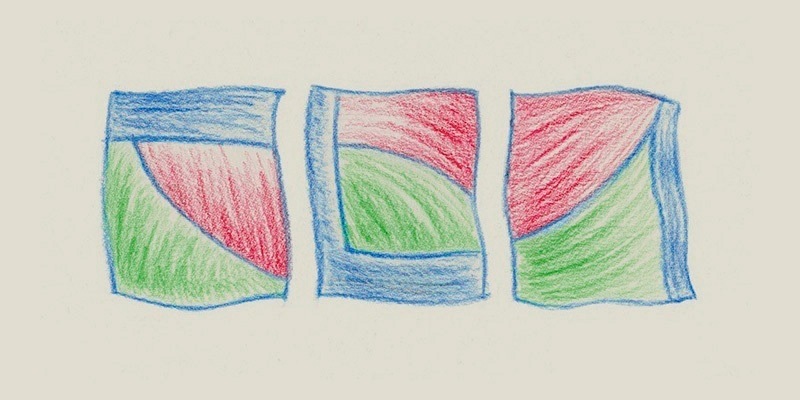
    "as it were", finally finished and available, is a collection of seventeen non-verbal compositions that visually explore the story as a form.
            Considering literary forms, one sees that a poem resides in a shape that is particular to it and inviolable.  A novel, on the other hand, exists in many pages that all look alike. A story occupies a limited enclosure with a consistent though malleable shape.
            Each story in this collection uses a different system of generators, each develops its own language. Like drawing, writing is visual and gestural, but with different constraints.  Without the force of semantic content holding the attention in a specific mode to the page, the differences between drawing and writing begin to soften and the act of looking and the act of reading begin to merge.
            Some of these stories feature asemic writing, others are abstract comics. We are used to listening to content, "as it were" is an opportunity to listen to visual form.  Note: this book contains no words.
available at Amazon  or  https://www.createspace.com/3453638


Saturday, May 29, 2010

Another World: 1.

Photos taken a couple days ago. Beginning of a longer series, which I'll post as I edit. No Photoshop, but a reflection into another world.


Thursday, May 27, 2010

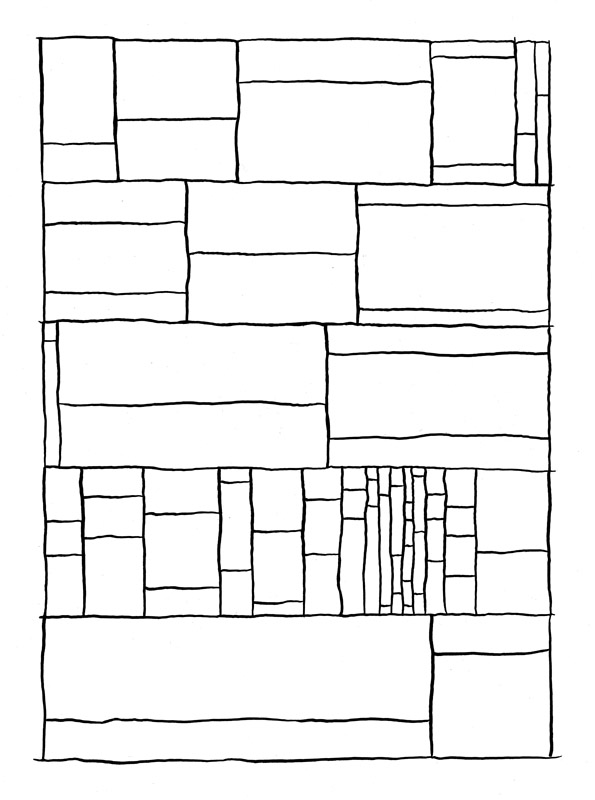
page by Hansjörg Mayer

here's a page from Hansjörg Mayer's series alphabetenquadratbuch 1 (1964-5), scanned from An Anthology of Concrete Poetry (Something Else Press, 1967). Mayer was a typographic designer & book publisher, as well as a visual poet.

Wednesday, May 26, 2010


Ismail
24"x36"
Acrylic

As the Paint Brush whispers his name the walls scream for his attention. The Love affair the three of them shared was starting to becoming a distant memory. The thing that they have yet to discover is that he has been carrying on an affair. The endless nights they use to make magic together are the memories that decorate his past. He tells himself all the time that this affair he's carrying on has brought him joy and wealth of the pocket. It makes him smile from the face and not the heart like his previous lovers. He misses them and dreams all the time of holding that beautiful tall slender brush and the rush his body gets when colours collide... He must make a date with his old lovers tonight and bring himself back to life.. Hoping that they missed him and longed for him in the same manner.
His lovers eagerly accept the invitation and promise he wont be sorry. No words are exchanged as the wall anticipates the combined touch of the soft silky brush. Jerome's heart hasn't beated this fast in months. The wall lets out a cry and the brush moans..Tonight they have again made a love child...Hopefully this one makes it to see the light of day so his beauty can be shared with the masses......

Written by: Ayana Ismail

Tuesday, May 25, 2010

Chaotic sequences


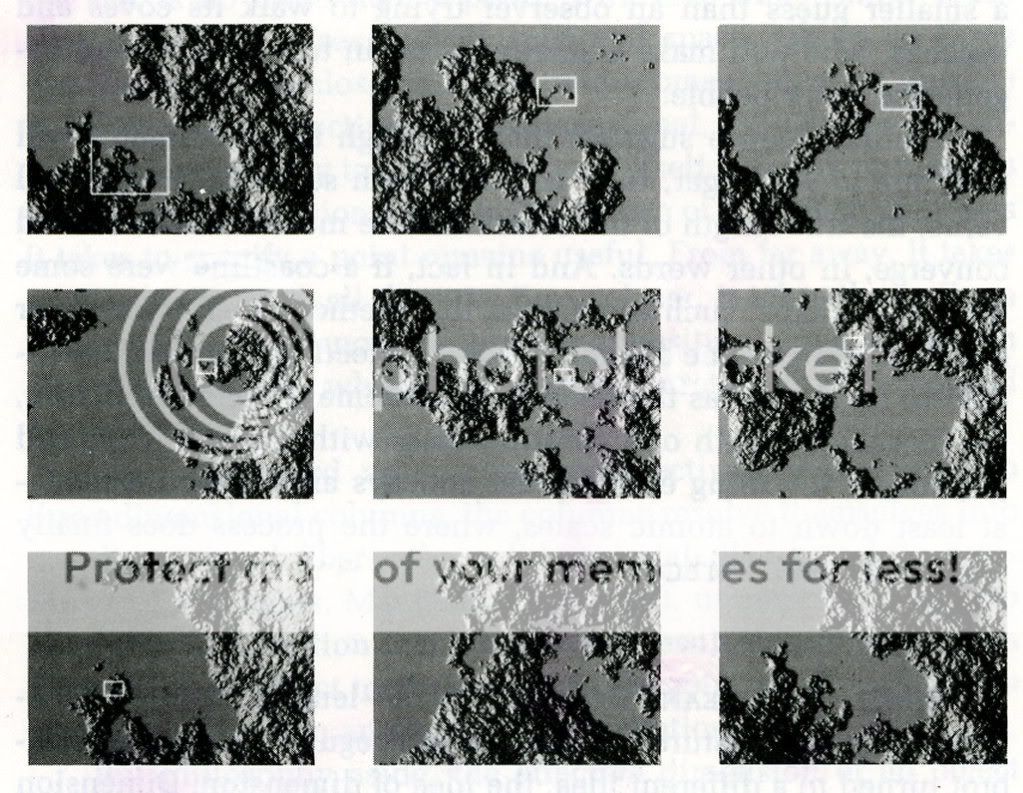
From the illustrations to James Gleick's Chaos: Making a New Science, 1987.

There are two kinds of beauty: free beauty (pulchritudo vaga), or beauty which is merely dependent (pulchritudo adhaerens). The first presupposes no concept of what the object should be; the second does presuppose such a concept and, with it, an answering perfection of the object. Those of the first kind are said to be (self-subsisting) beauties of this thing or that thing; the other kind of beauty, being attached to a concept (conditioned beauty), is ascribed to objects which come under the concept of a particular end.

Flowers are free beauties of nature. Hardly anyone but a botanist knows the true nature of a flower, and even he, while recognizing in the flower the reproductive organ of the plant, pays no attention to this natural end when using his taste to judge of its beauty. Hence no perfection of any kind — no internal purposiveness, as something to which the arrangement of the manifold is related — underlies this judgment. Many birds (the parrot, the hummingbird, the bird of paradise), and a number of crustaceans, are self-subsisting beauties which are not appurtenant to any object defined with respect to its end, but please freely and on their own account. So designs à la grecque, foliage for framework or on wallpapers, etc., have no intrinsic meaning; they represent nothing — no object under a definite concept — and are free beauties. We may also rank in the same class what in music are called fantasias (without a theme), and, indeed, all music that is not set to words.


--Immanuel Kant, Critique of Judgment, paragraph 16.